
August 2026 · Canadian Commercial Mortgages
By Nav Grewal, Principal Broker
Construction draws: how the money actually arrives.
The most expensive misunderstanding in construction financing is thinking of the loan as a lump sum. It isn't. A construction facility is a commitment that pays out in stages, in arrears, against work already completed and verified. Builders who plan cash flow around when money is spent rather than when it is reimbursed run out of it, usually mid project, at the worst possible price.
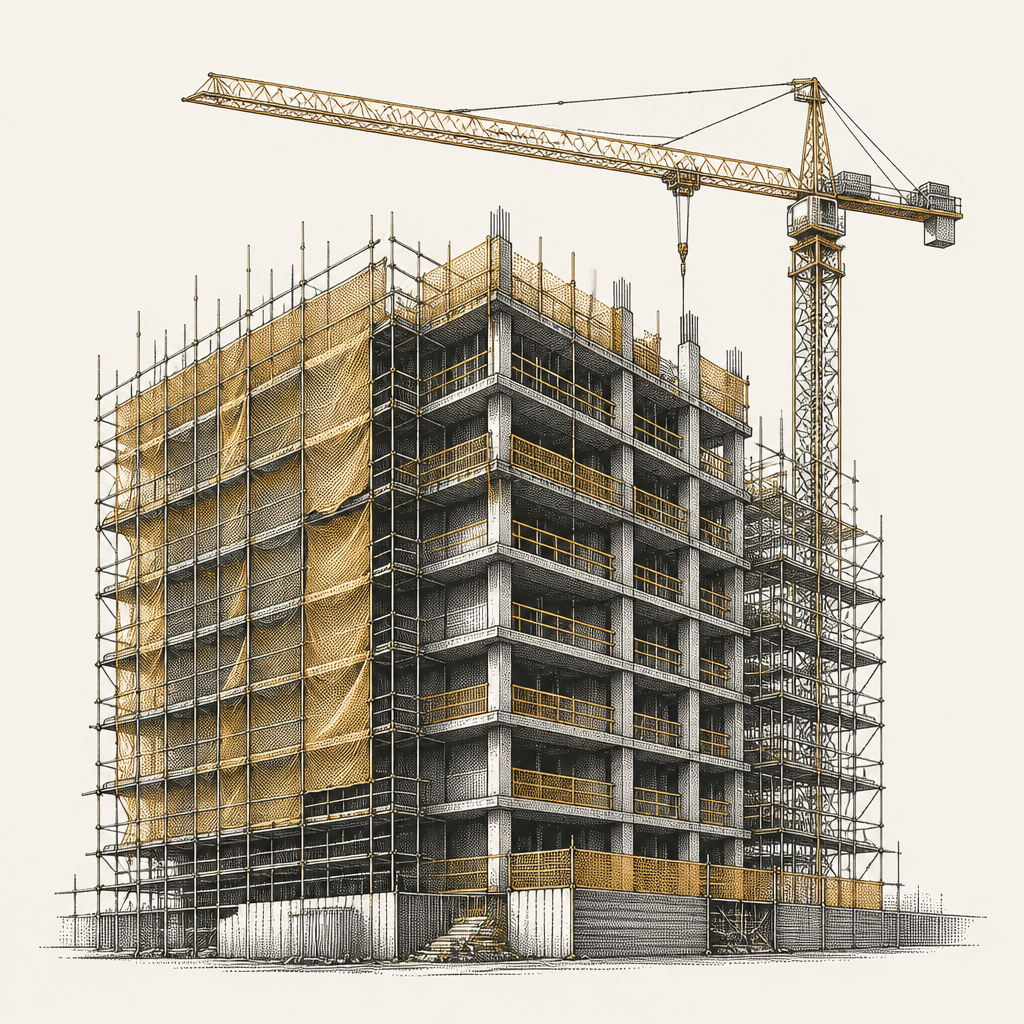
The core principle: cost to complete
At every moment of the project, the lender cares about one number: is there enough undrawn money left to finish the building? That is cost to complete underwriting. Each draw is sized so that remaining facility plus your remaining equity always covers remaining work. It is also why lenders make you spend your own equity first, by the time their money starts flowing, your capital is already in the ground and their loan is protected by finished work.
What a draw schedule really looks like
Schedules are negotiated per project, but a typical ground up deal advances in stages tied to verified completion:
| Stage | Typical cumulative completion | What the inspector verifies |
|---|---|---|
| Land / close | None | Equity in, permits, budget, fixed price contracts |
| Draw 1, Foundation | ~15% | Excavation, footings, foundation complete |
| Draw 2, Lock up | ~40% | Framing, roof, windows, building sealed |
| Draw 3, Drywall | ~65% | Mechanical, electrical, plumbing roughed in and covered |
| Draw 4, Completion | ~85% | Finishes, equipment, site works |
| Final draw | 100% | Occupancy permit, deficiencies cleared, liens clear |
Illustrative. Actual stages and percentages vary by project and lender.
Each draw follows the same loop: you request it, a quantity surveyor or cost consultant inspects and reports percentage complete against budget, the lender advances against that verified number, less holdback, and the cycle repeats. The loop typically takes one to three weeks from request to funds, which is the single most important number to build into your trade payment terms.
The 10% you can't have yet
In BC, the Builders Lien Act requires 10% of the value of work to be held back from payments, releasable 55 days after substantial completion. Lenders administer this inside the draw process: every advance arrives net of holdback, and the accumulated 10% lands near the end of the project. Two practical consequences: your trades need to carry that gap in their contracts, and your cash flow model must not count holdback as available funds until release. Ontario and Alberta run equivalent regimes with different release timing.
Interest doesn't wait for completion
Construction facilities are interest only during the build, charged monthly on the drawn balance, which means the carrying cost starts small and compounds toward the end. Most facilities fund this through an interest reserve: a line item in the budget the lender draws against automatically. If the project runs long, the reserve runs out, and topping it up becomes an equity call at the moment you have the least equity to spare. Schedule risk is interest risk.
Why draws stall, and how files are built so they don't
The draw requests that stall share the same patterns: work claimed but not complete at inspection, unpaid trade invoices surfacing as lien risk, change orders that moved the budget without lender sign off, and cost overruns that break the cost to complete math. The fix is mostly structural, and it happens before the first draw: a realistic budget with contingency the lender has already approved, fixed price contracts where possible, a draw schedule matched to how your trades actually invoice, and one person, usually the broker, reconciling the cost consultant's report against the request before it goes in. A clean draw file funds in days; a contested one funds in weeks.
When the draw structure itself is the problem
Some projects don't fit institutional draw discipline, the timeline is too tight for the inspection loop, the project is mid stream and needs rescue capital, or the numbers work but the paperwork doesn't yet. That is bridge and private territory: faster advances, lighter process, higher cost, used for a defined window. And when the building completes and leases, the construction facility hands off to term debt, often an insured refinance if the asset qualifies.
Draw questions we hear most.
Related reading and tools
Building something?
Send us the budget, the timeline and the site. We will structure a facility whose draw schedule matches how your project actually spends money.