
Building condition assessments for commercial mortgages
The appraisal tells the lender what the building is worth. The building condition assessment tells them what it will cost to keep it that way.
The short answer
A building condition assessment is an engineering consultant's review of a building's roof, envelope, structure, mechanical, electrical, life safety and site, which most BC commercial lenders require on income producing buildings, which the borrower pays for, and whose findings can turn into a repair holdback or a structural reserve that reduces the loan.
| Question | Short answer |
|---|---|
| Who does it | An engineering consultant |
| Who pays | The borrower |
| When | During the condition period, after the environmental report on sites with an industrial history |
| What it can change | Repair holdbacks, the structural reserve and so the loan amount |
What is a building condition assessment?
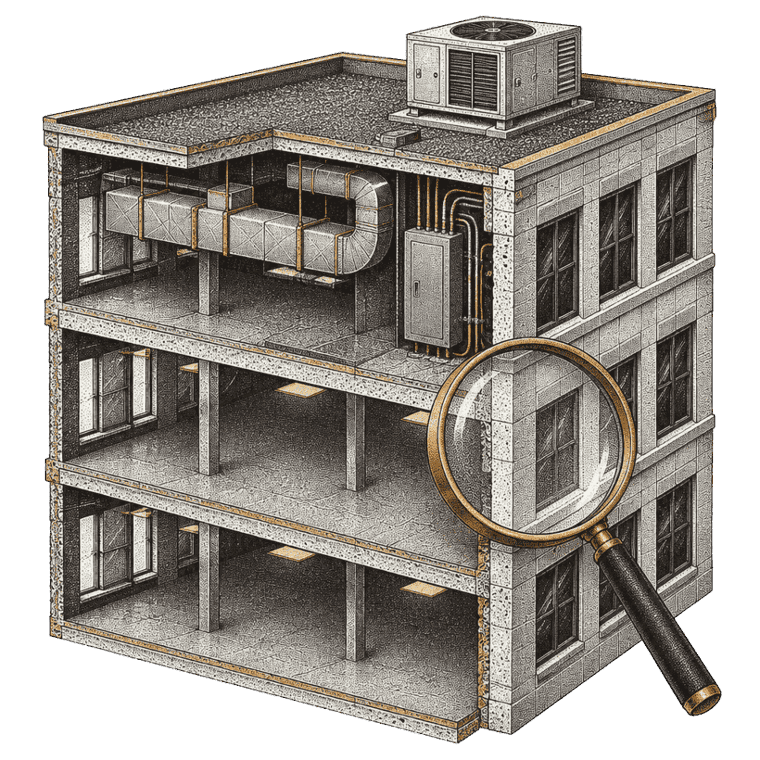
It is a report from an engineering consultant on the physical condition of a building. The consultant reviews the roof, the building envelope, the structure, the mechanical and electrical systems, life safety and the site.
The report separates what needs attention now from what will come due over the life of the building, and that split is what the lender works from.
Why lenders require one
The roof, the parking and the mechanical all come due eventually. A lender holding a mortgage on the building needs to know whether a large repair is coming that would eat into the income carrying the loan, or into the value securing it.
That is why a building condition assessment shows up as a condition of approval on most income producing buildings. See the full list of reports on commercial mortgage requirements in BC.
Who orders it and who pays
The report is written so the lender can rely on it, but it is paid by the borrower, in the same way as the appraisal and the environmental report.
None of these reports are financed on a conventional loan, so budget for them on top of the down payment. The full list of costs is on the BC commercial closing costs page.
Immediate repairs versus the capital plan
Items the consultant flags as urgent are usually dealt with through a repair holdback: part of the loan is held back at funding and released once the work is done.
Longer term items, the capital the building will need over the years, show up in the underwriting instead. Lenders deduct a structural reserve from net operating income, and a smaller income figure produces a smaller loan. You can see the effect in the commercial mortgage calculator.
Where it fits in the condition period
Order the reports in sequence rather than all at once. On a site with an industrial history the environmental report is the one most likely to stop the deal, so it goes first there, and the building condition assessment follows once the site is clear.
Spending on every report in the same week is how buyers end up paying for three reports on a purchase that one of them was always going to stop.
Strata property: the depreciation report
On a strata unit the building is owned in common, so the lender reads the strata documents rather than a report on your unit alone. That means the Form B, the depreciation report and the council minutes.
How lenders read those documents is covered on strata and leasehold commercial financing.
Building condition questions.
Related reading
Let's fund your next deal
Send the property and any reports you already have. A senior broker will tell you what the lender is likely to ask for, usually the same day.