
MLI Select for new construction.
Ground up rental is where this program is at its strongest. The points are cheaper to earn, the leverage is real, and the structure is two facilities rather than one.
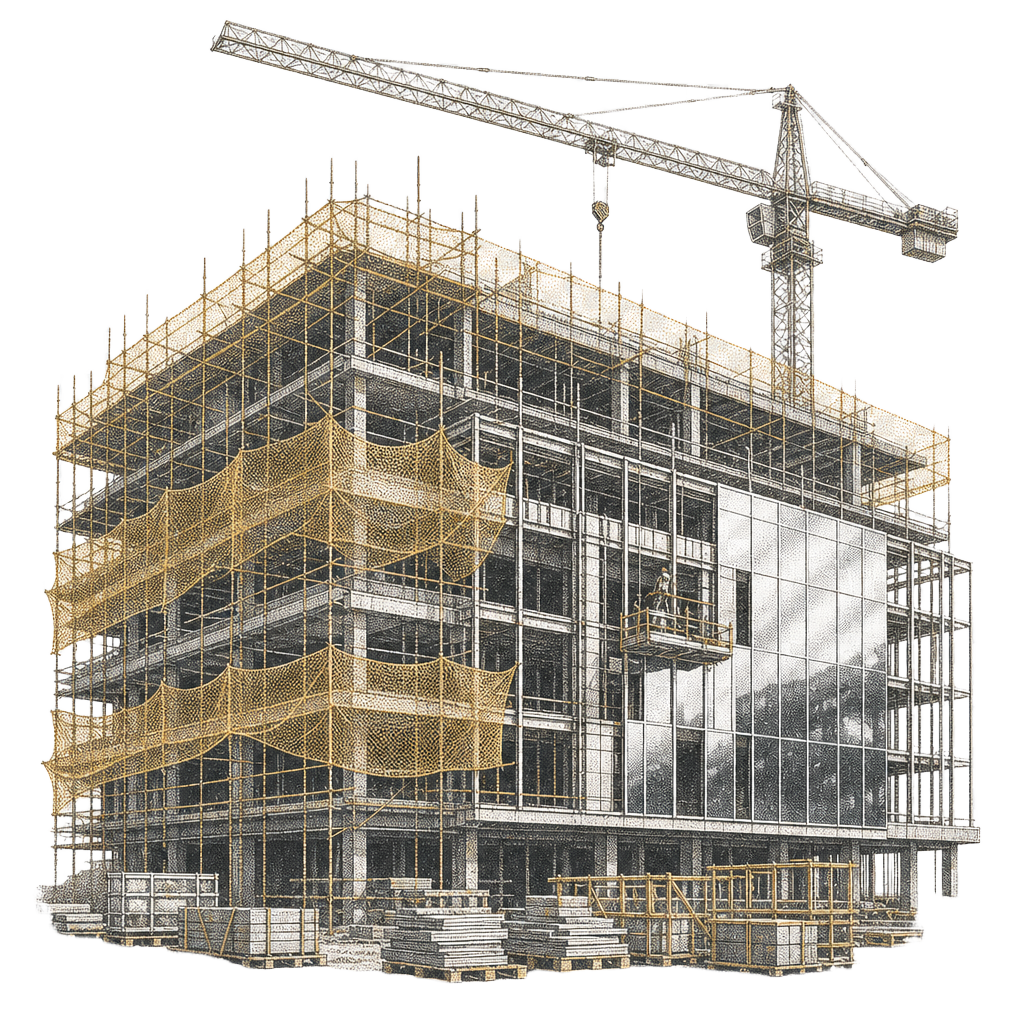
Why the program suits ground up rental
Purpose built rental has one structural problem: the cost to build has run ahead of what rents will carry at conventional leverage. A developer who can only borrow 65% or 70% of cost has to write an equity cheque large enough that the return no longer justifies the risk, which is why so many rental sites stayed as sites.
MLI Select attacks that from both directions at once. Leverage up to 95% cuts the equity requirement, and an amortization up to 50 years cuts annual debt service enough that the building can actually carry the loan. Add insured pricing, which sits well inside conventional commercial pricing, and a project that did not pencil at conventional terms frequently does. Nothing else available on rental property in this province does all three.
The parent explainer, the MLI Select program page, sets out the full tier table and what each tier buys.
Two facilities, not one
The most common misconception on ground up files is that MLI Select funds the construction. In almost every case it does not. The build is funded by a construction loan advanced against cost to complete, and the insured mortgage takes that loan out once the building is finished and leased. Two lenders, two credit processes, one project.
The two are joined at the exit. A construction lender is lending against a repayment source, and on a rental project that source is the takeout. So the insured file is arranged early, before or alongside the construction facility, because a credible insured commitment is what makes the construction loan cheaper and easier to place. Doing it in the other order, building first and arranging the takeout later, is how a project ends up refinancing under time pressure at whatever terms are available.
How the construction side actually advances, quantity surveyor reports, holdbacks and draw timing, is covered in construction financing and in our guide to how construction draws work.
The rental achievement period
The insurance is finalised against occupancy the building has actually reached, not against the pro forma that got it approved. After completion there is a rental achievement period during which the building leases up, and the takeout is confirmed against the rents and occupancy achieved in that window.
This is the moment where optimistic assumptions get expensive. If achieved rents land below the underwritten figures, or lease up runs slower than modelled, the insured loan resizes downward and the gap has to be filled with equity at exactly the point the construction loan is due. Lenders commonly hold back a portion of the takeout until achievement is confirmed, so plan the project with enough contingency to sit through a slower absorption than the market currently suggests.
Committed affordable units help here rather than hurting, because they lease quickly. The risk sits in the market rate portion of the building.
Points strategy is different on a new build
On an existing building, points are bought out of revenue you already collect. On a new build, they are designed in. That changes the order of operations completely.
Affordability thresholds on new construction are far lower: 10% of units earns 50 points, 15% earns 70 and 25% earns 100, against 40%, 60% and 80% on existing buildings. Committing one unit in ten to reach the qualifying score is a modest concession against what the leverage returns, which is why affordability usually carries the file on a ground up project and the other categories top it up.
Energy behaves differently again. On new construction it is measured against the national energy code baseline rather than against an existing building, so it is a design decision rather than a retrofit. Roughly 25% better than baseline earns 20 points, 50% better earns 35 and 60% better earns 50. Every one of those is decided by glazing, envelope and mechanical selection, which means the energy modeller belongs at concept stage. After the drawings are frozen the score is already set.
Realistic timelines
A complete MLI Select application typically runs 3 to 5 months from engagement to funding, and CMHC review alone commonly takes 8 to 12 weeks once the file is genuinely complete. That clock only starts when the submission is actually finished, so an incomplete package does not buy an earlier place in the queue.
On new construction, sequence those months against the build rather than after it. The insured commitment should be in hand before the construction facility closes, the build runs its own schedule, and the rental achievement period follows completion. Working backwards from an occupancy date is the only way this fits together without a gap, and gaps on development files get filled with expensive short term money.
New construction questions we hear most
Keep going on ground up rental
Let's structure the build and the takeout together.
Send the pro forma and the drawings. We will score the project, size the insured takeout and place the construction facility against it.